My wife knew I didn’t need 20 minutes in the bathroom. So did I.
I build mobile software for a living. My wife still noticed the problem before I did.
This one is different from what I usually write.
No AI. No interviews. No engineering deep dive.
This is something that bothered me for years. I eventually managed to fix it for myself, and I want to share what I learned along the way.

My wife knew I didn’t need twenty minutes in the bathroom.
So did I.
The first few minutes were legitimate. The rest belonged to my phone.
I wish I could say this happened once and became one of those stupid stories couples tell about each other. It didn’t. It was ordinary enough that neither of us really questioned it.
I would take my phone in with me, finish whatever I had actually gone there to do, and then stay.
Maybe I had opened a message. Once I answered it, I noticed something on LinkedIn. LinkedIn became the news. Something in the news reminded me of something I wanted to search for. That search gave me another thing worth opening.
Eventually I would stand up.
By then, the original reason for having the phone in my hand had disappeared so completely that I could barely remember what it was.
This would already be stupid enough if I did not build mobile software for a living.
For more than fifteen years, I have spent part of my working life thinking about tiny interactions like these. Can we remove a step? Can we preserve state? Can we make returning easier? Can we put the next useful action exactly where somebody expects to find it?
Most of that is simply good software.
Sitting on the toilet one evening, long after I had any practical reason to still be there, I realised I had become an extremely satisfied customer.
That was funny for a moment.
Then it became uncomfortable.
Because the bathroom was not really the problem.
The reason ended. I stayed.
Once I started watching the behaviour instead of simply feeling vaguely guilty about it, something became obvious.
Most of the time, I was not picking up my phone because I wanted to waste time. The first action was usually completely reasonable: answer a message, check an email, look at a map, read a notification, take a photo.
Thirty seconds of deliberate use.
The expensive part came afterward.
The message was answered, but the phone remained open. I had found the address, but there was a notification waiting. I dealt with that and noticed something else. One useful action quietly became a second action, then a third.
There was never a moment where I consciously thought, I would now like to spend the next twelve minutes wandering around my phone.
That decision never happened.
That was the interesting part.
I picked up the phone for a reason.
The reason ended.
I stayed anyway.
I eventually needed a precise way to describe that moment.
I called it Lost Intention.
It begins when you enter the phone without a clear purpose, or when you enter with a perfectly clear purpose and fail to notice when that purpose quietly turns into something else.
Once I could see it, the bathroom stopped looking like a weird isolated habit. It was simply the easiest place to catch myself doing something I was doing everywhere else.
On the sofa. In bed. Waiting for coffee. Before a meeting. Standing in a queue. In the thirty seconds while somebody else left the room.
The phone was extremely good at filling any moment that did not already contain something. I had become extremely bad at noticing when I had stopped choosing.
The toilet was done with me. My phone was not.
The bathroom made the problem unusually obvious because it has such a clear purpose. You go in for a reason. Eventually that reason is over.
The phone has no equivalent ending.
There is always one more thing. One more headline. One more notification. One more message. One more search. One more thing that takes ten seconds and leads naturally to another ten seconds.
My phone did not need to persuade me to stay there for another fifteen minutes. It only needed to make the next few seconds easier than getting up.
Then the next few. Then the next few.
Almost none of those tiny continuations felt important enough to count as decisions.
That was when I began to suspect I had been measuring the wrong thing.
Screen time measures the easy part
Like almost everybody, I had looked at my screen-time reports. They are wonderfully precise: three hours and forty-two minutes, five hours and eleven minutes, up twelve percent from last week.
Numbers like that look scientific enough that it is easy to assume they describe the problem. I no longer think they do. At least not by themselves.
I can deliberately spend an hour on my phone reading something I chose, talking to somebody, navigating somewhere, working, paying a bill or watching something I genuinely wanted to watch. That hour may be exactly what I intended.
Then there are seven minutes in the bathroom where I unlock the phone, move through five unrelated things and finish without a particularly good explanation for what I was doing.
The seven minutes bother me more.
The duration is smaller. The loss of intention is larger.
Screen time counts the width of the bar. Lost Intention counts the seams.
The seams were what I had been missing. How often did I enter without deciding? How often did useful use become automatic occupation? How often had the original reason disappeared while the behaviour continued?
The programmer part makes this worse
There is an embarrassing irony in spending fifteen years building mobile products and discovering all of this while sitting on a toilet too long.
I understand friction. Engineers spend a surprising amount of time removing it.
One fewer tap is usually preferable to two. An application should remember useful state. Returning should not require rebuilding everything from scratch. The common action should be easy to reach.
There is nothing inherently sinister about any of this.
But friction does something else too. Sometimes it gives you a chance to reconsider.
A small interruption can be the moment in which you realise you do not actually want to continue. Remove enough of those moments and continuing becomes easier than stopping.
I understood that professionally. Knowing it did not protect me.
For a while, I think understanding the machinery gave me the comfortable illusion that I somehow stood outside it.
I didn’t.
What engineering eventually gave me was not immunity. It gave me a better way to diagnose the failure.
When software repeatedly produces an unwanted result, we do not tell it to develop stronger character. We inspect the conditions.
What happened immediately before the failure? What became too easy? What state was the system in? Which constraint was missing? Why did the same path keep winning?
Those questions turned out to be much more useful than asking myself why I lacked discipline.
The latter was self-criticism. The former was debugging.
I know which one I am better at.
Then I noticed who else was paying
The bathroom part is funny.
The part with my wife was less funny.
We both work in technology, and over time we developed a completely ordinary habit of being together without quite being together.
One person checks something. The other checks something. A conversation pauses. A small silence appears, and instead of allowing the silence to exist, somebody fills it with a screen.
Nothing dramatic happens. Nobody walks out. Nobody announces that the relationship is in trouble.
In fact, if you had asked either of us whether anything was wrong, we probably would have said no.
That was exactly what bothered me.
The moments were too small to look serious on their own. Thirty seconds here. A quick check there. Something while the other person made tea. Another glance because the conversation had paused.
But enough small absences change what being together feels like.
You can be less than a metre away from somebody you love and still repeatedly leave the room without moving.
That was when I stopped thinking of this purely as a productivity problem.
If I waste twenty minutes, I lose twenty minutes. That is my bill.
Attention works differently.
Sometimes your phone habit does not cost you your time. It costs somebody else your attention.
And because the cost lands on them, they may notice the pattern long before you do.
The bathroom was only where I noticed the loop
Once I stopped treating these moments as random failures of discipline, the same pattern kept appearing.
Something happens. You reach. The useful action drifts into something else. Then doing it again becomes a little easier.
Eventually I reduced it to four stages:
Cue → Reach → Drift → Repeat
The bathroom might begin with boredom. Bed might begin with a notification. Work might begin with a task you do not particularly want to start.
The cue changes. The path is remarkably similar.
That explained why telling myself to “check less” had been such a weak intervention. I was fighting the reach while leaving everything around it untouched.
The cue was still there. The easy route was still there. The environment had not changed.
I was effectively asking willpower to win the same fight hundreds of times.
That is poor system design.
A better question was: what could I change so the fight did not have to happen every time?
Sometimes that meant removing a trigger. Sometimes it meant adding a little friction. Sometimes the phone was not even the real problem. The problem was boredom, avoidance, anxiety or a task I did not want to begin.
The phone was simply the easiest exit available.
Deleting one app does not necessarily fix that. You may just find another exit.
The point is not to make the device unusable. It is to understand the loop and change the conditions that keep producing it.
I still use my phone all the time
I did not buy a dumb phone. I did not delete every app. I did not decide technology had ruined humanity and move into the woods.
I use my phone for work, maps, banking, messages, cameras, authentication, travel, family and dozens of things I am glad it can do.
I also still build software for phones.
The goal was never to stop using the device. I wanted something much more specific.
I wanted to notice sooner when I was no longer using it on purpose.
That meant changing some defaults, removing some hooks, adding useful friction in a few places and accepting that I would still fail sometimes.
And yes, occasionally it meant leaving the phone outside the bathroom.
Not because the bathroom was special. Because it was the one place where the absurdity became impossible to explain away.
I had finished. I knew I had finished. My wife knew I had finished.
Yet somehow I was still there.
The question that finally helped
The first useful step was not a detox. It was a question.
The next time you notice yourself holding your phone, ask:
What did I pick this up to do?
Then ask:
Am I still doing it?
That is all.
Not because those questions magically solve the habit. They do something more useful first.
They expose it.
If the answer to the second question is yes, carry on. If the answer is no, watch what happens next.
Does the phone go down? Or does your thumb simply find somewhere else to go?
That tiny transition was the thing I had spent years measuring incorrectly.
The reason ended. I stayed.
Once I could finally see that moment, I could start changing what happened around it.
And occasionally I could just get off the toilet.
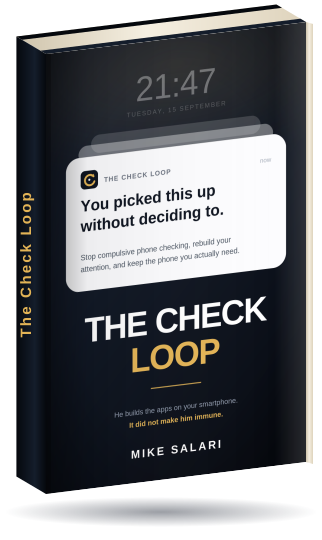
The Check Loop
I kept testing these ideas until they became a system I could actually use. I did not write it because I wanted people to abandon their phones. I wrote it to make the moment between intentional use and automatic use visible, and to change the conditions around it.
The complete kit: the book, printable field cards, Phone Rebuild Checklist, Three-Column Log, 90-Day Review, iOS and Android walkthroughs, and a seven-day field test.
No subscription. No app telling you to stop using apps.
Get The Check Loop →