Why you keep scrolling after you've done what you picked up your phone for
You picked up your phone for a reason.
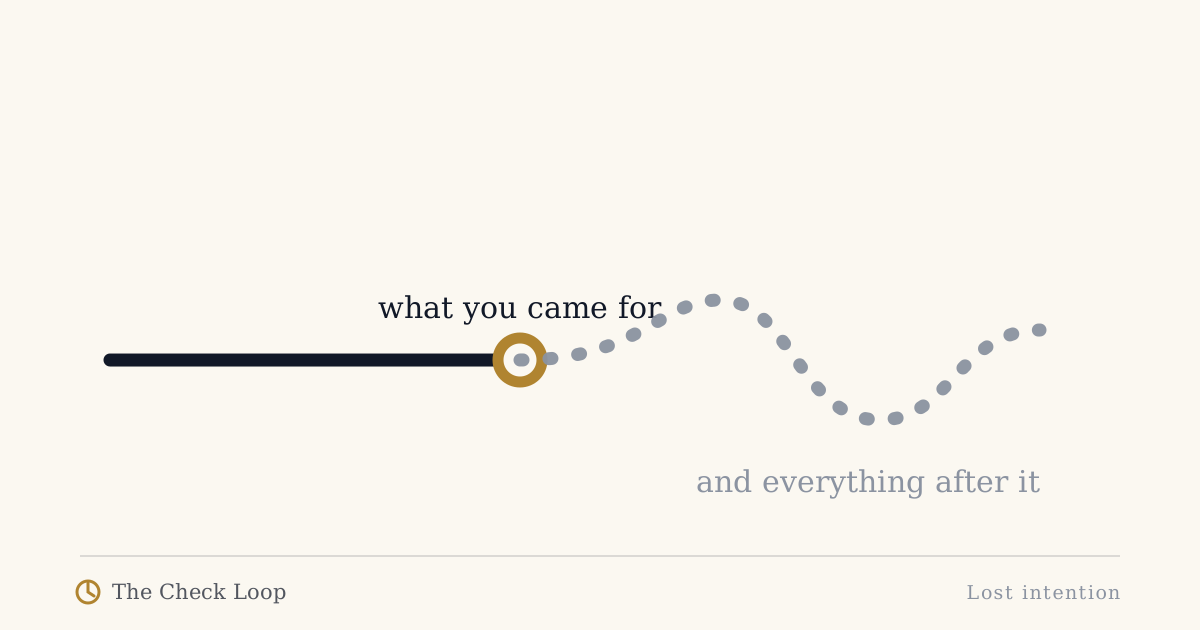
You picked up your phone for a reason.
You checked the weather. Replied to a message. Approved a login. Looked up an address. Sent a photo.
The task took thirty seconds.
Ten minutes later, you are still on the phone.
That is not the same problem as opening your phone "for no reason". The session began intentionally. The intention simply did not survive the session.
I call this Lost Intention.
Lost Intention happens when the purpose that justified opening the phone has ended, but the phone session continues without a new deliberate choice.
It is one of the most important distinctions in The Check Loop because it explains why a phone can feel distracting even when much of your use is legitimate.
The phone was not the problem at the beginning
Many attempts to change phone use begin with the wrong assumption: that the phone should not have been opened.
But sometimes it absolutely should have been.
Modern phones are cameras, maps, authenticators, payment devices, work tools, messaging systems, calendars, scanners, boarding passes, music players, and actual phones.
The useful task is real.
The problem begins at the boundary between done and still here.
A message reply ends. The app shows a feed.
A map search ends. Another notification is visible.
A banking task ends. Your thumb returns to the home screen and opens something familiar.
Nothing dramatic happened. There was simply no strong stopping cue.
Screen time cannot show you where the intention ended
Suppose you spend twelve minutes on a social app.
A screen-time dashboard can tell you the duration. It cannot necessarily tell you this sequence:
- Minute 0-2: reply to a friend.
- Minute 2-3: read another message.
- Minute 3-12: scroll without deciding to start a scrolling session.
From the dashboard's perspective, that may be one twelve-minute block.
From your perspective, the first two minutes and the final nine minutes are not equivalent.
Research on meaningful and meaningless smartphone use supports the broader idea that the quality and purpose of phone use cannot be reduced to duration alone. In a 2018 study, Kai Lukoff and colleagues examined what made smartphone use feel meaningful or meaningless to users rather than treating all minutes as interchangeable.
Lost Intention is a practical way to focus on a specific boundary inside that broader problem: when did the original purpose end?
Why stopping is often harder than starting
A lot of digital-wellbeing tools focus on access.
They ask:
- Can I block the app?
- Can I delay entry?
- Can I set a timer?
- Can I hide the icon?
Those can help, but Lost Intention often happens after access was justified.
The harder question is:
What tells me that the useful part is finished?
Most digital environments are designed to keep the next action obvious. There is another post, another video, another message, another recommendation, another refresh.
The end of your task is rarely treated as a meaningful event.
So the session inherits momentum.
In The Check Loop, this is the movement from Reach into Drift.
The reach may have been completely intentional. Drift begins when the purpose is gone and the next action is selected by availability rather than decision.
Lost Intention is not the same as doomscrolling
Doomscrolling is usually associated with prolonged consumption of upsetting, negative, or anxiety-provoking information.
Lost Intention is broader.
You can lose intention while looking at:
- harmless memes,
- sports scores,
- shopping,
- short videos,
- email,
- Reddit,
- news,
- photos,
- a work chat.
The content does not need to be negative.
The defining feature is that you are still there after the reason for being there has ended.
This makes Lost Intention useful even for people who do not identify with "doomscrolling", "phone addiction", or digital detox culture.
The fix is not to make every useful task painful
If you add too much friction to every phone interaction, you may eventually remove it.
That is predictable.
Research on digital self-control tools suggests people want support that is strong enough to change behavior without becoming excessively coercive. A 2022 analysis by Ulrik Lyngs and colleagues examined hundreds of digital self-control tools and found that users value support that fits their own definition of distraction and does not simply make legitimate use miserable.
For Lost Intention, the most useful friction may come after the intended task, not before it.
Examples:
- Open a message from a notification or search rather than entering through a feed-first home page.
- Put open-ended apps away from the place you return to after a task.
- After sending a message, lock the phone before deciding whether to do something else.
- Use a simple phrase such as "done means down" for one repeated context.
- If you want to continue, name the new purpose: "I am choosing ten minutes of Reddit now."
That last step matters.
The goal is not to prohibit the second activity. It is to make it a second decision.
A useful test: would I have opened the phone for what I am doing now?
When you notice yourself in a session, ask:
If the phone were locked right now, would I unlock it specifically to do what I am currently doing?
If the answer is yes, the current activity may be chosen.
If the answer is no, you may be inside Lost Intention.
This question works because it mentally recreates the boundary that disappeared.
You are not asking, "Is this app bad?"
You are asking, "Would I choose this action from zero?"
That is a much cleaner test.
Track transitions, not just minutes
For one week, choose three common entry tasks:
- messaging,
- weather,
- maps,
- banking,
- email,
- authentication,
- camera.
Each time you use one, record:
- Why did I pick up the phone?
- When was that task finished?
- Did I lock the phone then?
- If not, what happened next?
You may discover that one transition causes most of the drift.
For example:
WhatsApp reply -> Instagram -> 14 minutes
or
2FA -> home screen -> Reddit -> 8 minutes
That is much more actionable than learning that your daily average was 3h 11m.
Now you know where to change the environment.
Design an exit, not a punishment
A good exit is small.
It might be:
- lock immediately after the intended action,
- stand up and put the phone back in its place,
- return an app to a neutral screen before closing it,
- use search or a direct link to enter a specific destination,
- add a reminder that appears when the intended app closes,
- remove the next high-drift app from immediate view.
You do not need a theatrical reset.
You need a reliable boundary between one chosen action and the next.
Lost Intention changes what "better phone use" means
If you only optimize for fewer minutes, you can accidentally punish useful phone use.
If you optimize for preserved intention, the target becomes clearer:
- Useful tasks should remain easy.
- Automatic entry should become slightly less easy.
- The end of a useful task should become easier to notice.
- Continuing should become a fresh choice.
That is the heart of intentional phone use.
Not abstinence.
Not a perfect screen-time score.
Not winning a daily argument with yourself.
A session should have a reason to begin and, ideally, a reason to continue.
When the reason disappears, that is the moment to notice.
That is Lost Intention.
Continue
- Why Do I Keep Checking My Phone for No Reason?
- The Check Loop: Cue, Reach, Drift, Repeat
- How to Use Your Phone More Intentionally
- Phone Friction
The free sample includes the core Lost Intention exercise and shows how to trace one real phone session through the Check Loop.
Sources
- Lukoff, K., Yu, C., Kientz, J., & Hiniker, A. (2018). What Makes Smartphone Use Meaningful or Meaningless? Proceedings of the ACM on Interactive, Mobile, Wearable and Ubiquitous Technologies. https://doi.org/10.1145/3191754
- Lyngs, U., Lukoff, K., Csuka, L., Slovák, P., Van Kleek, M., & Shadbolt, N. (2022). The Goldilocks level of support: Using user reviews, ratings, and installation numbers to investigate digital self-control tools. International Journal of Human-Computer Studies, 166, 102869. https://doi.org/10.1016/j.ijhcs.2022.102869
The Check Loop
The Check Loop is a field manual for noticing automatic phone use, adding useful friction, and keeping the smartphone you actually need.