How to use your phone more intentionally
Intentional phone use does not mean using your phone as little as possible.
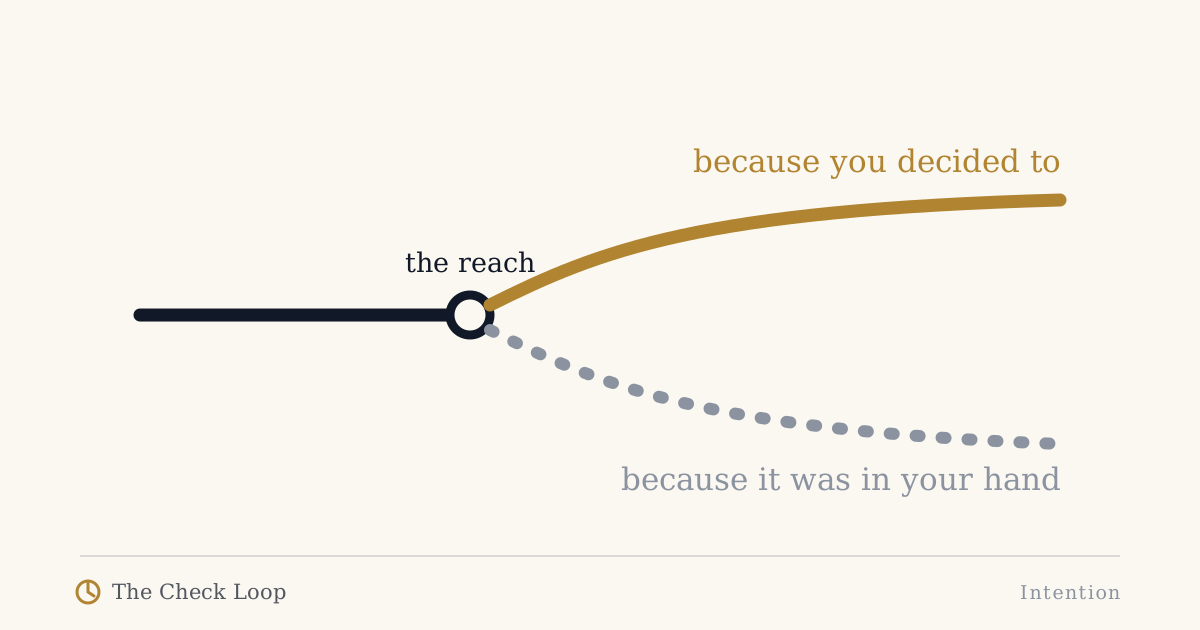
Intentional phone use does not mean using your phone as little as possible.
It means making more of your phone use chosen.
You can spend an hour deliberately talking to a friend, navigating a city, reading a book, editing photos, or watching something you wanted to watch. That hour may be more aligned with your life than ten minutes of fragmented checking that interrupts work, dinner, and a conversation.
So the goal is not to force every person toward one "healthy" screen-time number.
A more useful question is:
Did I mean to begin this session, and did I keep choosing it as it continued?
That is the standard The Check Loop is built around.
Intentional does not mean minimal
A lot of digital-wellbeing advice quietly assumes that lower usage is always better.
That is too crude for a device that now carries essential parts of everyday life.
The phone can be useful precisely because it consolidates so many functions:
- communication,
- navigation,
- work,
- banking,
- authentication,
- photography,
- reading,
- music,
- travel,
- entertainment.
The problem is not that these functions exist.
The problem is that useful access and open-ended distraction often occupy the same device, one gesture apart.
Intentional phone use tries to preserve the first without pretending the second can be solved by shame.
Measure the quality of sessions, not only the number of minutes
Research has already questioned the idea that all smartphone time is psychologically equivalent.
Kai Lukoff and colleagues studied what makes smartphone use feel meaningful or meaningless to users. Their work is useful because it focuses on the character of use rather than treating duration as the only outcome worth discussing.
More recently, a 2026 Virgin Media O2 commissioned study pushed "unintentional phone use" into mainstream language. The company reported that more than a third of measured/reported phone use in its study occurred without a clear purpose. Because the research was commissioned by a telecom company, those prevalence figures should not be treated as neutral population truth. But the language is revealing: people increasingly recognize a difference between time online and time they actually meant to spend there.
Your own measurement can be simpler.
For one week, classify sessions as:
- Chosen: I knew why I opened the phone.
- Useful but extended: I completed the task, then stayed without making a new decision.
- Automatic: I noticed the phone was open before I could name a purpose.
The second category is what I call Lost Intention.
Learn your Check Loop
The Check Loop is a practical model:
Cue -> Reach -> Drift -> Repeat
Cue
Something makes the phone feel relevant.
It can be an alert, boredom, waiting, stress, task difficulty, or simply seeing the device.
Reach
The device enters your hand and becomes the next available action.
Drift
You continue beyond the original purpose, or move into an activity you did not decide to start.
Repeat
The phone returns to a position or state that makes the next check likely.
Intentional use does not require eliminating every cue. It requires understanding which loops repeatedly create use you later wish you had not chosen.
Preserve the useful path
Before adding friction, decide which paths should remain fast.
For example, perhaps you want:
- camera access instantly,
- calls from family to interrupt you,
- maps to remain one tap away,
- work authentication to remain convenient,
- messaging to remain available,
- music controls to stay easy.
Then decide which paths should stop being the default:
- opening a social feed whenever you unlock,
- reading news during every pause,
- checking email after its purpose is already complete,
- opening Reddit while waiting for a build,
- moving from one useful app into another open-ended one.
This distinction prevents intentional phone use from turning into a punishment system.
Add friction where automaticity happens
Friction is any small design choice that creates a moment for a decision.
It can be physical:
- phone out of immediate reach,
- a fixed charging place,
- not carrying it into one high-drift context.
Or digital:
- fewer interruption rights,
- a less stimulating home screen,
- delayed access to one app,
- search instead of one-tap entry,
- a Focus mode for one context.
Research on digital self-control tools suggests that one-size-fits-all restriction is not ideal. Users tend to value interventions that match their personal definition of distraction and offer enough support without feeling excessively coercive.
That is why The Check Loop treats friction as adjustable, not absolute.
Make stopping a decision too
Most digital-wellbeing systems focus on whether you can enter an app.
But a large amount of unintentional use begins after a legitimate task.
You reply to a message. The purpose is complete. The phone is still open.
That is Lost Intention.
A simple rule can help:
When the original purpose ends, lock the phone before choosing the next purpose.
You can unlock it again immediately.
The point is not the lock itself. The lock creates a boundary.
Without a boundary, the next activity inherits momentum from the previous one.
With a boundary, continuing becomes a fresh decision.
Chosen entertainment still counts as intentional use
If you deliberately decide to spend twenty minutes watching short videos, that is different from waking up forty minutes later wondering how you got there.
Intentionality is not a synonym for productivity.
You are allowed to use technology for pleasure.
A system that only validates work will eventually be ignored.
A better system distinguishes:
- entertainment you chose,
- entertainment that chose the next hour for you.
That is a more honest standard.
Do not turn every impulse into a personal failure
Some environments are built to make continued engagement easy. Autoplay, infinite feeds, badges, recommendations, and immediate access reduce the number of moments at which a person has to decide again.
A 2026 Virgin Media O2 study found that respondents themselves frequently pointed to notifications, autoplay, and infinite scrolling as factors in how often they checked and how long they stayed. Again, that is commissioned research, so use it as market and self-report evidence rather than proof of a universal causal effect.
The practical lesson is still useful:
If the environment repeatedly produces behavior you do not prefer, redesigning the environment is a legitimate use of agency.
You do not prove strength by keeping every temptation one tap away.
A simple intentional-phone setup
Start with five changes.
1. Give the phone a physical home
When it is not actively needed, it goes somewhere predictable.
2. Decide which alerts deserve interruption rights
Not every notification is important enough to create a new task in your brain.
3. Make the first screen boring but useful
Put deliberate utilities close. Move open-ended feeds farther away.
4. Add one pause before your highest-drift app
Not every app. One.
5. End useful tasks cleanly
When the purpose is complete, lock the phone or put it back before choosing what happens next.
Run that setup for a week before adding more rules.
What should you measure instead of only screen time?
Screen time is still useful. It is just incomplete.
Track a few behavioral signals:
- number of purposeless unlocks you notice,
- number of sessions that continue after the task ends,
- number of high-cost interruptions during work or relationships,
- contexts where checking is most automatic,
- interventions you actually keep enabled.
A successful week might not produce a dramatic decline in total minutes.
But it may produce fewer unplanned interruptions and more cleanly ended sessions.
That can be a much more meaningful improvement.
The standard is deliberate, not perfect
You will still check automatically sometimes.
You will still lose intention.
You will still ignore your own system occasionally.
That does not make the system useless.
The question is whether your environment now gives you more opportunities to decide.
Intentional phone use is not a detox, a dumb-phone identity, or a contest for the lowest daily number.
It is a practical relationship with a useful device:
Open it for a reason. Notice when that reason ends. Make the next action a choice.
Continue
- The Check Loop
- Lost Intention
- Phone Friction
- Your Screen Time Looks Normal. Why Does Your Phone Still Feel Distracting?
The free sample contains the core field test for mapping your own phone use before changing it.
Sources
- Lukoff, K., Yu, C., Kientz, J., & Hiniker, A. (2018). What Makes Smartphone Use Meaningful or Meaningless? https://doi.org/10.1145/3191754
- Lyngs, U., et al. (2022). The Goldilocks level of support. https://doi.org/10.1016/j.ijhcs.2022.102869
- Virgin Media O2 (2026). UK on track to spend nearly five years on their phones unintentionally, landmark study finds. Commissioned study. https://news.virginmediao2.co.uk/uk-on-track-to-spend-nearly-five-years-on-their-phones-unintentionally-landmark-study-finds/
The Check Loop
The Check Loop is a field manual for noticing automatic phone use, adding useful friction, and keeping the smartphone you actually need.