The Check Loop: Cue, Reach, Drift, Repeat
The Check Loop is a practical framework I use to explain a common kind of phone use:
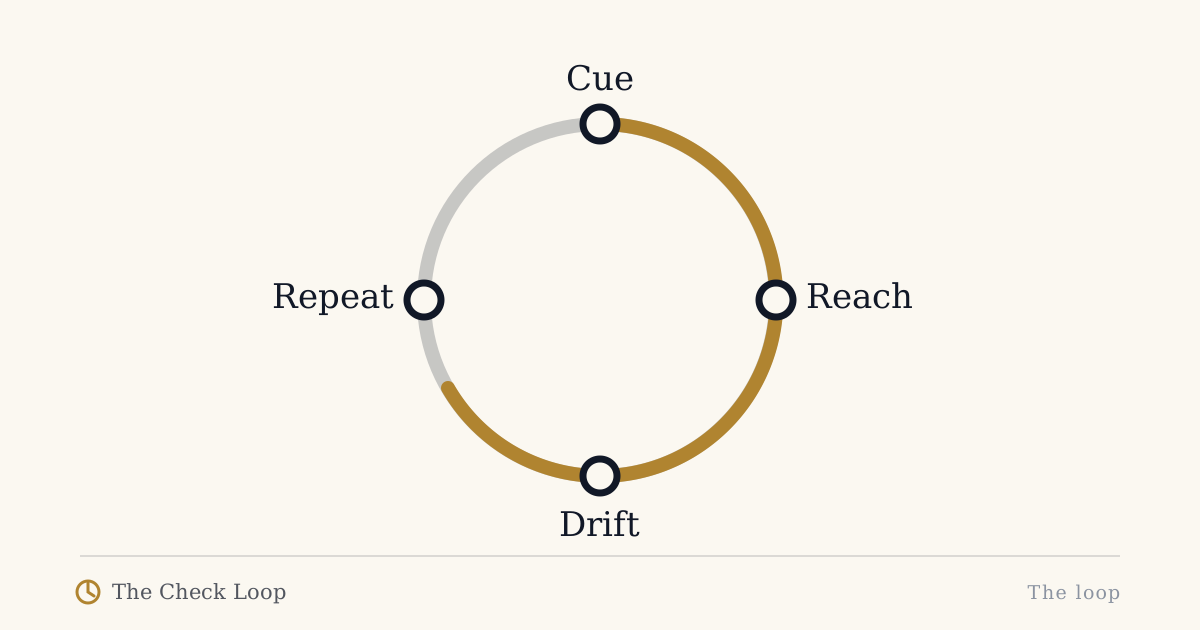
The Check Loop is a practical framework I use to explain a common kind of phone use:
Cue -> Reach -> Drift -> Repeat
It is not a clinical model, and I am not presenting it as a scientific consensus framework. It is a way to inspect ordinary phone behavior at the level where a useful change can actually be made.
The core idea is simple:
A phone session rarely begins at the screen. Something happens before the screen. Then the phone becomes the next action. Then the session may continue beyond its original purpose. Then the environment resets in a way that makes another check likely.
If you treat all four stages as one problem called "too much screen time", you lose useful information.
If you separate them, you can change the part that matters.
Stage 1: Cue
A cue is the condition that makes the phone feel like the next available action.
The obvious cues are external:
- a notification,
- a vibration,
- a badge,
- the screen lighting up,
- someone else taking out their phone.
But a cue can also come from inside you:
- boredom,
- anticipation,
- uncertainty,
- a difficult work task,
- waiting,
- loneliness,
- discomfort,
- a moment with no obvious next action.
Research on spontaneous smartphone checking is especially relevant here. Berntsen and colleagues describe phone-directed attention that can occur without an external prompt and without a specific conscious goal.
That is important because it prevents a common mistake: assuming every automatic check must have been caused by a notification.
Sometimes the cue is simply a familiar state paired with a familiar response.
Stage 2: Reach
The reach is the transition from cue to device.
It can be so fast that the reason is constructed after the phone is already in your hand.
You finish a paragraph.
You reach.
A build starts.
You reach.
The conversation pauses.
You reach.
You sit down in the bathroom.
You reach.
The reach matters because this is often the cheapest place to intervene.
Once you are inside a highly engaging app, asking yourself to stop may require more effort than creating a small pause before entry.
That pause can be physical, digital, or contextual.
Examples:
- phone outside immediate reach during deep work,
- one extra gesture before a high-drift app,
- no nonessential notifications in a specific context,
- a fixed place for the phone at dinner,
- asking "what am I opening this for?" before unlocking.
The point is not to create a fortress around the device. It is to give intention time to arrive before the habitual action completes.
Stage 3: Drift
Drift is what happens when the current phone activity is no longer clearly connected to the reason the phone was opened.
This can happen in two ways.
Drift after an automatic reach
You opened the phone without a clear purpose, so the first available content defines the session.
Drift after an intentional reach
You had a legitimate purpose, completed it, and kept going.
I call the second pattern Lost Intention.
For example:
reply to message -> task complete -> feed -> another app -> 14 minutes
The original phone use was justified. The drift happened at the boundary after the task.
That is why "just use an app blocker" can be a bad fit. If you need the app for legitimate tasks, making entry impossible may create more friction than you are willing to keep.
The intervention may need to make stopping more visible rather than making starting impossible.
Stage 4: Repeat
After one session ends, what makes the next session likely?
The answer is often environmental.
The phone returns face-up beside the keyboard.
Badges remain visible.
The next idle transition occurs with the device already in your hand.
The same app sits in the same thumb position.
The same notification source is allowed to interrupt again.
Repeat is the stage that turns a few seconds of checking into a daily pattern.
It is also easy to ignore because nothing dramatic happens there.
You simply reset the system to the same conditions that produced the behavior before.
A better reset may be as small as putting the phone back in a fixed place after each intentional use.
Where does Lost Intention fit?
Lost Intention usually sits between Reach and Drift.
You had a reason to reach.
That reason ends.
The next action does not receive the same level of conscious approval.
This distinction is essential because a useful phone session can become an unchosen session without any clear moment of "giving in".
Nothing failed morally.
The system simply had no boundary.
Read the full definition: Lost Intention.
How is this different from a generic habit loop?
Many behavior models use concepts such as cue, routine, response, and reward. The Check Loop is not an attempt to replace that literature.
It is deliberately narrower.
It is designed around the mechanics of a modern smartphone session, especially two points that generic habit language can blur:
- Drift after a legitimate task. The phone use can start intentionally and still become unintentional.
- Repeat through device state and environment. The way the phone is returned to the environment shapes how easy the next check becomes.
That makes the model practical for questions such as:
- Why do I check with no notifications?
- Why do I keep scrolling after replying to one message?
- Why does my phone interrupt coding even when my screen time is not extreme?
- Why do app limits annoy me without changing the underlying pattern?
Interventions by stage
Instead of collecting random tips, match the change to the stage.
If the problem is Cue
Reduce low-value interruption rights.
Change visual exposure.
Notice internal cues such as boredom or task difficulty.
If the problem is Reach
Increase physical distance.
Add one intentional gesture.
Name the purpose before unlocking.
If the problem is Drift
Use direct-to-purpose entry paths.
Create an exit after the intended task.
Lock the phone before starting a second activity.
If the problem is Repeat
Return the phone to a neutral physical location.
Clear unnecessary badges.
Avoid leaving the next high-drift app as the most available action.
The best intervention is often small because it is specific.
A worked example: coding
Imagine this sequence:
Cue: a build takes forty seconds.
Reach: the phone is beside the keyboard, so you pick it up.
Drift: you open Reddit with no specific purpose.
Repeat: the build finishes, but the phone remains beside your hand. Ten minutes later, the next test run triggers the same sequence.
A generic solution might be "use less phone".
A Check Loop solution can be much narrower:
- move the phone behind the laptop during coding,
- keep authentication available,
- decide that build waits are not phone cues,
- if you intentionally check a message, put the phone back before returning to code.
You changed the environment without redesigning your entire digital life.
A worked example: messaging at night
Cue: you remember you need to reply to someone.
Reach: intentional.
Drift: the reply ends, but you open another app.
Repeat: you place the phone on the pillow, ready for another check.
The useful intervention is not necessarily blocking messages.
It may be:
- reply,
- lock,
- place the phone back on the charger,
- make any further use a separate decision.
That is an exit design problem, not an access problem.
How to map your own loop
For seven days, collect a few examples in this format:
Cue:
Reach:
Drift:
Repeat:
Do not record every phone interaction. Capture the ones that felt unchosen, disruptive, or longer than intended.
After a week, look for repetition.
You may find that most of the cost comes from one context rather than the whole device.
That is good news because a specific loop is easier to redesign than "my relationship with technology".
The point of the model
The Check Loop is not a score and it is not a diagnosis.
It is a way to ask better questions.
Instead of:
How do I become disciplined enough to stop using my phone?
Ask:
What cue keeps starting this?
Why is the reach so easy here?
Where does the original purpose end?
What makes the next check likely?
Those questions lead to changes you can actually test.
The phone stays useful.
You just stop asking willpower to solve a design problem every five minutes.
Continue
- How to Stop Automatic Phone Checking
- Lost Intention
- Phone Friction
- How to Use Your Phone More Intentionally
For the full field-test method, see The Check Loop book.
Sources
- Berntsen, D., Hoyle, R. H., Møller, D. M., & Rubin, D. C. (2023). Digital daydreaming: Introducing the spontaneous smartphone checking scale. https://doi.org/10.1002/acp.4034
- Monge Roffarello, A., & De Russis, L. (2023). Achieving Digital Wellbeing Through Digital Self-Control Tools: A Systematic Review and Meta-Analysis. https://doi.org/10.1145/3571810
The Check Loop
The Check Loop is a field manual for noticing automatic phone use, adding useful friction, and keeping the smartphone you actually need.