Your Screen Time looks normal. Why does your phone still feel so distracting?
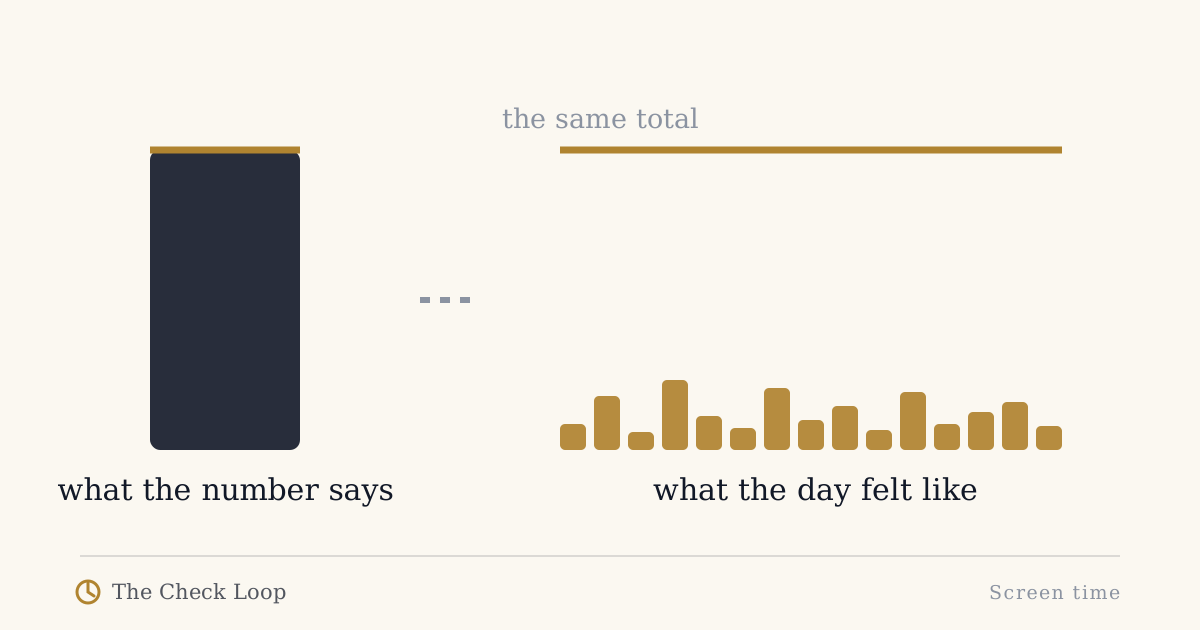
Because total time and total disruption are not the same thing.
Because total time and total disruption are not the same thing.
You can have a screen-time number that looks moderate and still experience your phone as intrusive if the use is fragmented, badly timed, or unintentional.
Ten minutes of deliberate reading is not the same experience as ten one-minute checks scattered through a difficult piece of work.
Thirty minutes of a chosen video call is not the same as thirty minutes accumulated through dozens of tiny interruptions around your family.
Screen time is useful data. It is just not the whole model.
Screen time answers one question well
Screen-time dashboards are good at answering:
How long was the device or app active?
That can reveal obvious problems.
If one app consumes hours you did not intend to spend, duration matters.
But screen time does not automatically tell you:
- why you opened the phone,
- how many times you interrupted another task,
- whether the use was chosen,
- whether you continued after your original purpose ended,
- whether the session happened during a high-cost context,
- whether the phone displaced something you cared about.
Those are different questions.
Frequency can matter even when duration is modest
Imagine two workdays.
Day A
You use your phone for forty minutes at lunch.
Day B
You use it for forty minutes total, but the time is spread across forty short checks during writing, coding, meetings, and thinking.
The daily total is the same.
The attentional shape is not.
Experimental research has shown that phone notifications can disrupt performance on an attention-demanding task even without direct interaction with the device. That does not mean every notification ruins a work session. It does mean interruption itself can carry a cost that duration-only metrics do not capture.
If your phone feels distracting, look at when the minutes occur, not only how many there are.
A session can start intentionally and end unintentionally
This is another blind spot.
You open the phone to complete a useful task.
The task ends after one minute.
You remain for nine more.
The dashboard reports ten minutes.
It does not mark the point at which the reason ended.
I call that Lost Intention.
Lost Intention matters because it lets you preserve legitimate phone use while still identifying the part of the session you did not choose.
Read: Why You Keep Scrolling After You've Done What You Picked Up Your Phone For.
Meaning matters, not just quantity
Research on smartphone use has explored distinctions between use people experience as meaningful and use they experience as meaningless. That line of work is important because it challenges a purely quantitative view of digital wellbeing.
A high-duration activity can be meaningful.
A low-duration activity can be irritating and disruptive.
The Check Loop adds another practical distinction:
chosen versus unchosen transitions.
You may not need a dramatically lower total. You may need fewer moments where the phone becomes the next action without a decision.
"Normal" screen time is not a useful personal target
There is a strong temptation to ask for one number:
How many hours is healthy?
But even a population average would not tell you what your phone is doing inside your specific day.
A designer using a phone for camera testing has a different pattern from someone watching videos for leisure.
A parent coordinating family logistics has different demands from someone on holiday.
A commuter using maps, tickets, music, and reading may accumulate significant screen time without experiencing the same problem as a person making constant micro-checks during work.
This is why The Check Loop does not begin with a universal daily limit.
It begins with the pattern.
Measure these four things for a week
If total screen time is not explaining the problem, add four lightweight measures.
1. Purposeless unlocks you notice
How often do you find the phone open before you can name why?
You do not need a perfect count. You need enough observations to see the pattern.
2. Lost Intention events
How often does a legitimate task turn into unrelated continued use?
3. High-cost interruptions
Mark checks that occur during:
- coding,
- writing,
- meetings,
- conversation,
- meals,
- bedtime,
- family time.
These may matter more than longer phone sessions in low-cost contexts.
4. Repeat contexts
Where does the same loop keep happening?
- desk,
- bed,
- bathroom,
- sofa,
- commute,
- queues,
- work breaks.
Contexts give you something concrete to redesign.
Your pickups metric can help, but it is not the answer either
Some phones report pickups or unlocks.
That can reveal fragmentation that total time hides.
But pickups still need interpretation.
Ten purposeful authentication checks during a workday are not identical to ten reflexive social checks.
Metrics become useful when connected to intention.
Do not replace "screen time obsession" with "pickup obsession".
Use the numbers to ask better questions.
A 2026 shift toward intentionality
In 2026, Virgin Media O2 published commissioned research centered explicitly on "unintentional phone use" and introduced a Digital Intentionality Score. The company reported that 36% of phone use in its study occurred without a clear purpose.
Those numbers should be treated carefully because the research was commissioned by the company, not used as a universal prevalence estimate.
But the framing is significant.
The mainstream conversation is moving toward a problem many people already recognize: the phone can feel wrong not only because of how much it is used, but because of the gap between intended and actual use.
That is exactly the gap worth measuring.
What a better goal can look like
Instead of:
Get below two hours a day.
Try:
- no automatic checks during a 90-minute coding block,
- reply to bedtime messages without entering another feed,
- phone off the dinner table,
- deliberate social media after lunch rather than during every pause,
- fewer phone checks triggered by boredom in queues.
Your total may fall as a side effect.
But the goal is tied to a behavior you actually care about.
When screen time is still the right metric
Do not throw it away.
Screen time is useful when:
- duration itself is the problem,
- you are losing large blocks of time,
- you want to compare a change before and after an intervention,
- a specific app is consuming far more time than intended.
The mistake is asking one metric to explain every kind of phone problem.
A better definition of progress
Your phone may feel less distracting before your daily average changes dramatically.
Progress can look like:
- uninterrupted work blocks,
- fewer automatic unlocks,
- conversations without checking,
- useful tasks ending cleanly,
- social use that begins because you chose it,
- fewer moments of wondering how you ended up in an app.
That is not invisible progress.
It is simply progress that a single duration number cannot fully represent.
Continue
- How to Use Your Phone More Intentionally
- Lost Intention
- The Check Loop
- What Is Unintentional Phone Use?
The free sample includes a seven-day field test built around the pattern of use rather than a universal screen-time target.
Sources
- Lukoff, K., Yu, C., Kientz, J., & Hiniker, A. (2018). What Makes Smartphone Use Meaningful or Meaningless? https://doi.org/10.1145/3191754
- Stothart, C., Mitchum, A., & Yehnert, C. (2015). The attentional cost of receiving a cell phone notification. https://doi.org/10.1037/xhp0000100
- Virgin Media O2 (2026). UK on track to spend nearly five years on their phones unintentionally, landmark study finds. Commissioned research. https://news.virginmediao2.co.uk/uk-on-track-to-spend-nearly-five-years-on-their-phones-unintentionally-landmark-study-finds/
The Check Loop
The Check Loop is a field manual for noticing automatic phone use, adding useful friction, and keeping the smartphone you actually need.