What is unintentional phone use? Why Screen Time does not tell the whole story
Unintentional phone use is phone use that happens without a clear prior purpose, or continues beyond the purpose that originally justified opening the device.
Unintentional phone use is phone use that happens without a clear prior purpose, or continues beyond the purpose that originally justified opening the device.
That is a useful everyday definition, but the terminology around this area is not fully standardized.
Different research and commercial frameworks describe related pieces of the problem using different language:
- spontaneous smartphone checking,
- meaningful versus meaningless smartphone use,
- unintentional phone use,
- Lost Intention.
They should not be treated as interchangeable scientific terms.
This article separates them.
Spontaneous smartphone checking is a peer-reviewed research construct
In 2023, Dorthe Berntsen and colleagues introduced the Spontaneous Smartphone Checking Scale.
They described spontaneous smartphone checking as directing attention toward a smartphone without an external prompt such as an alert and without a specific conscious goal.
That definition is especially useful for a familiar behavior:
You find the phone in your hand and only afterward ask what you meant to do.
It also matters because the construct does not require an incoming notification.
The cue can be internal or contextual.
Meaningful and meaningless use describe another dimension
In 2018, Kai Lukoff and colleagues studied what makes smartphone use feel meaningful or meaningless to users.
That work matters because it challenges a simplistic assumption that duration is enough to judge phone use.
Two sessions of equal length can have very different value.
One may support a relationship, solve a problem, or provide chosen entertainment.
Another may feel like time the user did not really mean to give away.
Meaningfulness is not identical to intentionality, but the concepts overlap in an important way: both ask what the use meant to the person, not only how many minutes passed.
"Unintentional phone use" became mainstream language in 2026
In June 2026, Virgin Media O2 published the results of a year-long commissioned study involving more than 6,000 participants at its peak and centered its public framing on unintentional phone use.
The company reported that 36% of phone use in the study occurred without a clear purpose and introduced a "Digital Intentionality Score".
Those figures should be treated carefully.
This was commissioned company research, not a neutral population prevalence study, and it should not be cited as if it settled how much phone use is unintentional for everyone.
But it is important as market-language evidence.
"Intentionality" is no longer a niche digital-minimalism word. It is becoming part of the mainstream digital-wellbeing conversation.
Lost Intention is The Check Loop's practical term for a specific transition
I use Lost Intention for a narrower pattern:
The phone session starts with a legitimate purpose. That purpose ends. The session continues without a new deliberate choice.
Example:
- open phone to reply to a message,
- reply complete,
- open feed,
- continue for twelve minutes.
That is different from spontaneous checking.
With spontaneous checking, the session may begin without a clear conscious goal.
With Lost Intention, the session begins intentionally and becomes unintentional later.
Both can produce the same screen-time total.
They require different interventions.
The Check Loop connects the pieces
The Check Loop is my practical framework:
Cue -> Reach -> Drift -> Repeat
It is not a peer-reviewed clinical model.
It is a way to decide where a behavior-design change belongs.
Cue
What made the phone relevant?
Reach
Did you decide to pick it up, or did the movement happen before the purpose became clear?
Drift
Did the current activity remain connected to the original reason?
Repeat
What state did the environment return to after the session?
Spontaneous checking often appears around Cue and Reach.
Lost Intention appears around the shift into Drift.
Repeat explains why the same pattern keeps reappearing in the same contexts.
Unintentional is not the same as bad
Not every spontaneous action needs to be eliminated.
Humans do many things automatically.
You may unlock the phone, see a family photo, check one useful message, and move on.
The important question is whether the pattern creates costs you care about.
For example:
- work is repeatedly interrupted,
- time with a partner becomes fragmented,
- bedtime keeps expanding,
- every moment of boredom becomes a check,
- an intended thirty-second task repeatedly becomes ten minutes.
Intentionality is a useful lens because it avoids turning every minute into a moral judgment.
Unintentional is not the same as addiction
This distinction is equally important.
Automatic or unintentional checking does not by itself establish a clinical disorder.
The Check Loop is not an addiction-treatment framework and this site is not a clinical tool.
If phone or internet use is causing serious impairment, distress, or feels impossible to manage, professional support may be appropriate.
For everyday behavior design, however, it is often more productive to begin with the observable sequence rather than a diagnostic label.
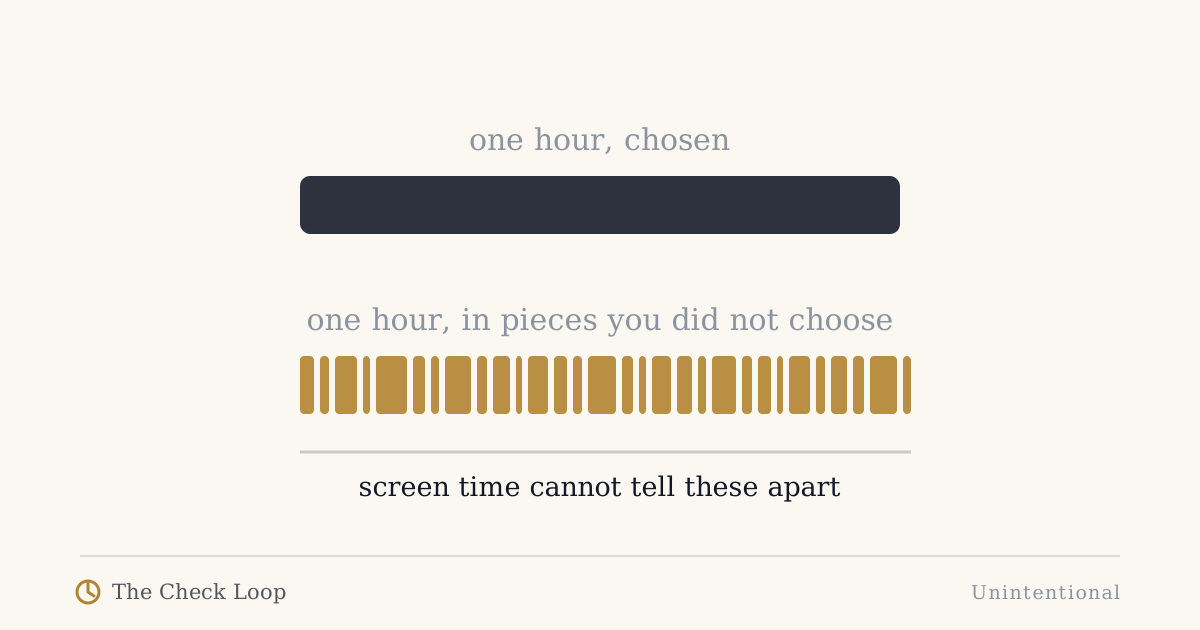
Why screen time cannot measure intentionality by itself
A screen-time dashboard can report duration by app.
It cannot reliably report:
- whether you had a purpose before unlocking,
- the moment that purpose ended,
- whether the next app was deliberately chosen,
- whether the session interrupted something more important,
- whether a repeated context triggered the reach.
That is why two identical totals can represent very different phone lives.
A useful measurement system should add context.
How to measure your own unintentional use
Do not try to label every second.
For seven days, sample the sessions you notice.
Ask three questions:
1. Did I know why I was opening the phone before I unlocked it?
If no, mark automatic entry.
2. Did I stop when the original purpose ended?
If no, mark Lost Intention.
3. Did this happen in a context where the interruption mattered?
Mark the context:
- work,
- coding,
- bed,
- bathroom,
- conversation,
- family,
- commute,
- waiting.
After a week, the pattern should be more useful than a single daily total.
What should change first?
If most unintentional use begins before the unlock, focus on Cue and Reach:
- reduce unnecessary alerts,
- move the phone,
- add entry friction,
- create a purpose check before unlocking.
If most unintentional use begins after a useful task, focus on Drift:
- make the task ending visible,
- lock the phone before choosing a second activity,
- create direct-to-purpose entry paths.
If the same pattern restarts every few minutes, focus on Repeat:
- reset where the phone goes,
- remove the visual cue,
- return to a neutral state.
This is why the label matters less than the sequence.
A better question than "How much phone is too much?"
For many people, the more useful question is:
How much of my phone use still feels like mine?
That does not produce a neat universal number.
It produces something more actionable: a map of where decisions disappear.
You can then preserve the useful phone and change the parts that happen by default.
That is the territory The Check Loop is designed to address.
Continue
- How to Use Your Phone More Intentionally
- Why Do I Keep Checking My Phone for No Reason?
- Lost Intention
- The Check Loop
The free sample contains a field test for separating automatic entry from Lost Intention in your own phone use.
Sources
- Berntsen, D., Hoyle, R. H., Møller, D. M., & Rubin, D. C. (2023). Digital daydreaming: Introducing the spontaneous smartphone checking scale. https://doi.org/10.1002/acp.4034
- Lukoff, K., Yu, C., Kientz, J., & Hiniker, A. (2018). What Makes Smartphone Use Meaningful or Meaningless? https://doi.org/10.1145/3191754
- Virgin Media O2 (2026). UK on track to spend nearly five years on their phones unintentionally, landmark study finds. Commissioned research. https://news.virginmediao2.co.uk/uk-on-track-to-spend-nearly-five-years-on-their-phones-unintentionally-landmark-study-finds/
The Check Loop
The Check Loop is a field manual for noticing automatic phone use, adding useful friction, and keeping the smartphone you actually need.