Why your digital detox didn't stick, and what to change when the phone comes back
A digital detox can help and still fail to change what happens afterward.
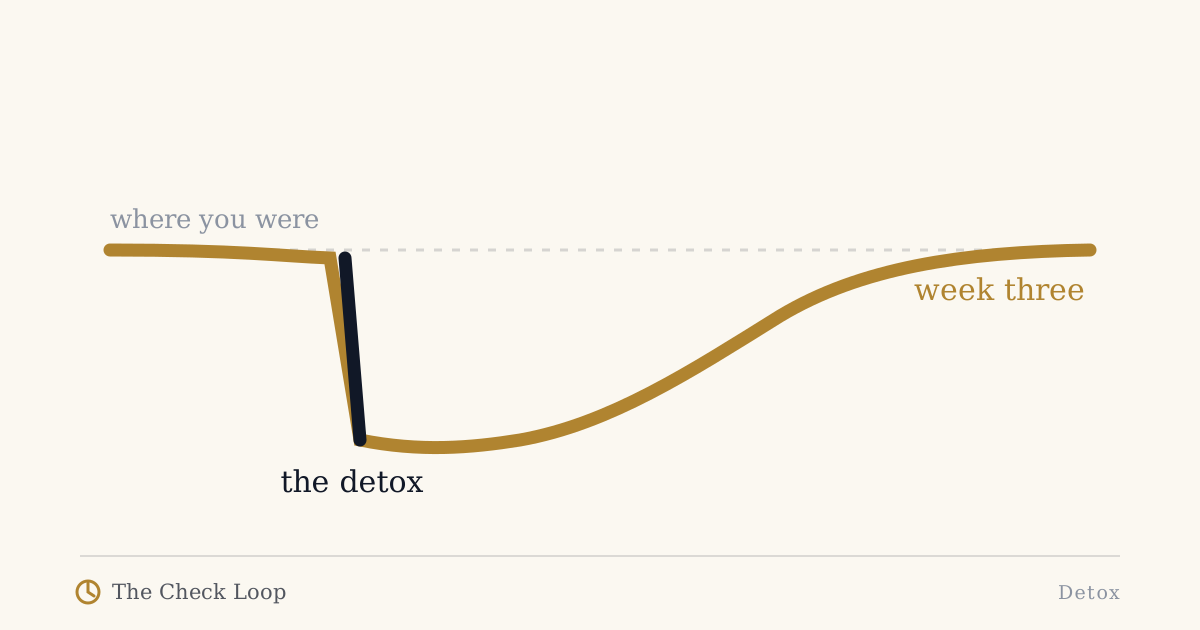
A digital detox can help and still fail to change what happens afterward.
Those two statements are compatible.
Taking a break from smartphone internet access or selected apps can reduce exposure and create distance. Some recent experimental research has found benefits from substantial temporary reductions in smartphone internet use. Other randomized work has found less durable effects on usage after an intervention period.
So the useful question is not, "Do digital detoxes work?"
It is:
What did the detox change, and what was waiting for you when it ended?
If the same cues, app placement, notifications, easy access, and transition habits are waiting on day one after the reset, the old Check Loop can restart quickly.
A detox changes exposure. It does not automatically redesign the return.
Imagine spending two weeks without social apps.
During those two weeks, the cue-to-reach path is interrupted because the usual destination is unavailable.
Then you reinstall everything.
The icons return to the same place.
Notifications return.
The phone returns beside the bed.
The same work pauses still happen.
The same boredom still happens.
The same feed is still one tap away.
Nothing about the underlying environment necessarily changed.
That does not mean the break was pointless.
It means abstinence and redesign are different interventions.
Research does not support a simple "detox is useless" story
This distinction matters because digital-wellbeing content often swings between extremes.
One side promises a detox will reset your brain and solve everything.
The other says detoxes are pointless because people eventually return to technology.
The evidence is more complicated.
A Georgetown University summary published in 2025 described research in which participants cut smartphone internet access for two weeks. The intervention produced improvements across several outcomes for participants who complied with the protocol.
A separate 2025 randomized controlled trial on planning a digital detox reported that smartphone usage time did not change significantly in the post-intervention period, while self-efficacy improved and predicted lower usage.
Different interventions, samples, outcomes, and follow-up periods can produce different results.
The Check Loop does not need to deny any of that.
Its narrower claim is practical:
A temporary reset does not automatically change the conditions that produce the old behavior when access returns.
Why the old pattern comes back
The Check Loop is:
Cue -> Reach -> Drift -> Repeat
A detox often interrupts the middle by removing access.
But after the detox:
The Cue can remain
Boredom, waiting, task difficulty, loneliness, and notifications still happen.
The Reach can become easy again
The phone returns to the same physical position.
Drift can return
Open-ended feeds, recommendations, and familiar app transitions are available again.
Repeat can reset the pattern
The phone goes back beside the keyboard, on the sofa, or next to the pillow.
The system is restored.
So the first week back matters more than most detox plans admit.
Do not return to your old setup by default
Before reinstalling or re-enabling everything, decide what the phone should look like after the break.
Ask four questions.
1. Which phone uses did I actually miss?
Be specific.
Messaging friends is not the same as checking a feed.
Maps are not the same as news.
Music is not the same as short-form video.
Restore the useful function, not automatically the entire old path.
2. Which cues disappeared during the detox?
Did your checking decline because you removed notifications?
Because the phone was physically elsewhere?
Because the app did not exist?
Because you stopped carrying the device into one context?
Preserve the useful part of that change.
3. Which apps need easy access?
Not every app deserves the same position.
Put utilities close.
Make open-ended destinations slightly more deliberate to reach.
4. What will tell me a useful task is finished?
If you reinstall a messaging or social app for legitimate communication, plan for Lost Intention.
How will you end a useful session before it becomes an unrelated one?
A post-detox return plan
Instead of reinstalling everything on one day, use a staged return.
Stage 1: essential utilities
Restore maps, banking, authentication, transport, camera, calendar, and anything you genuinely need.
Stage 2: communication
Restore messaging and work communication with notifications configured intentionally.
Stage 3: open-ended media
Bring back feeds, news, or entertainment only after deciding:
- where they live,
- when they can interrupt,
- what friction they need,
- how you will exit a session.
This is not a moral hierarchy. It is a design hierarchy based on how open-ended each use is.
The detox can become a diagnostic experiment
A break is especially useful if you treat it as a test rather than a purification ritual.
During the break, notice:
- which cues still make you reach for the missing app,
- which situations feel easier without it,
- which functions you genuinely need,
- which problems simply migrate to another app or device,
- whether boredom becomes uncomfortable or simply visible.
That information helps you build a better return environment.
Without observation, you may only learn that you can tolerate a temporary restriction.
With observation, you learn what was driving the loop.
What if the detox helped a lot?
Then keep what worked.
You do not need to reject a successful intervention because it has the label "detox".
Maybe you discovered that:
- the phone should not live in the bedroom,
- one social app is not worth reinstalling,
- you prefer using a service in the browser,
- weekends feel better with fewer notifications,
- you want entertainment on a tablet instead of your phone.
Those are environment-design decisions.
Keep them.
The goal is not ideological consistency. The goal is a setup that produces phone use you actually choose.
What if you relapsed immediately?
Do not respond by making the next detox harsher before you understand the failure.
Map one loop.
Example:
Cue: difficult work task.
Reach: phone beside laptop.
Drift: news -> social feed.
Repeat: phone stays on desk.
The next intervention could be much smaller than another two-week break:
- phone behind laptop during focus work,
- news notifications off,
- social app removed from first screen,
- chosen news check at lunch.
That is a system you may be able to keep indefinitely.
A reset is an event. A system is what happens every day.
Digital detoxes can be useful events.
But daily phone use happens in an environment.
If you want the effect to survive the detox, redesign the environment before the old behavior is fully restored.
Do not ask the break to do work it was never designed to do.
Use it to see the loop more clearly.
Then change the loop.
Continue
- Phone Friction
- How to Use Your Phone More Intentionally
- Why App Limits Don't Work for You
- The Check Loop
The book focuses on building a repeatable system for normal smartphone life rather than requiring permanent abstinence.
Sources
- Brockmeier, L. C., et al. (2025). Planning a digital detox: Findings from a randomized controlled trial to reduce smartphone usage time. Computers in Human Behavior, 168, 108624. https://doi.org/10.1016/j.chb.2025.108624
- Georgetown University (2025). Digital Detoxes Work. Here's What Reduced Screen Time Can Do For You. https://www.georgetown.edu/news/digital-detox-reduce-screen-time-benefits/
- Monge Roffarello, A., & De Russis, L. (2023). Achieving Digital Wellbeing Through Digital Self-Control Tools. https://doi.org/10.1145/3571810
The Check Loop
The Check Loop is a field manual for noticing automatic phone use, adding useful friction, and keeping the smartphone you actually need.